When Astra came out, Patrick saw people using it for Blender projects, games, and 3D generation. He had never done any 3D modeling. He didn't have a game to ship or an app that needed a mascot. He had Bufo.
Bufo, also known as Worry Frog, is a 2D character Patrick likes. So he gave Astra a few reference images and asked it to make the frog in 3D, mostly to see what would happen. On X he put it plainly: "Okay, so I've been playing with Astra and its ability to do 3D stuff. I also love Bufo, aka Worry Frog. These were all done with Astra." (thread)
That's the whole premise. It was play. But it turned into a pretty good test of a narrower question: can an agent turn a flat, very specific drawing into a character that still looks like itself from every side, and then make it move?
Why Bufo is a hard test
Bufo works as a drawing because of a handful of odd details. The eyes sit in a particular place. The snout is blunt. The body is round and a little slumped. The expression is worried in a way that's almost vacant, like he just remembered he left the stove on but isn't sure he owns a stove.
A drawing only has to get those details right from one angle. A 3D character has to get them right from all of them. The frog needs a side, a back, and a three-quarter view, and all of them have to agree with each other. Then, if he's going to move, the parts need to stay attached.
So there were really two questions. Does Bufo survive being turned around? And once he does, can he act without falling apart?
A pretty render is not a model
The first answer looked like a 3D Bufo. It wasn't one. It was a rendered image: a single picture with 3D-style lighting, not an object anyone could rotate, rig, or animate.
Patrick asked to see it and noticed the legs were wrong. He supplied a standing reference, and the agent fixed the render. Then he asked the question a single image can't answer: what does he look like from the other side?
To answer that, the agent had to build an actual mesh. It exported one as a 3D file and rendered a six-view turntable. It described the legs and feet as holding up from every angle.
They did not hold up from every angle. In the side view, the eyes stuck way out from the head, as if they'd been placed nearby rather than attached. The body and legs read as separate primitive shapes stacked together. It was technically a 3D object, and you could technically spin it around. Spinning it around was exactly what showed it needed to be rebuilt.
The six-view working render and Blender files are private. The public clips below show the later character, not this rejected mesh.
This is the core difference the experiment kept running into. A render only has to convince you from where the camera is. A model has to convince you from wherever the camera goes next. The agent's own description said the mesh worked. The turntable said otherwise, and Patrick believed the turntable.
The Blender revisions
Patrick handed the work to Astra, which rebuilt the character in Blender and produced a new set of views. This version was much closer. The body was one continuous shape. The eyes were set into the head instead of floating near it. The belly and limbs were cleaner.
Patrick still thought the side view looked flat. From the front, Bufo read fine. From the side, he looked a bit like he'd been pressed in a book.
So the revisions went one feature at a time:
- A plumper body, so the side view had some volume.
- A snout that projected farther from the face.
- A correction when one version made the snout too pointy. It went wider and rounder, back toward Bufo's blunt shape.
- Two small nostrils, set into the snout.
Patrick accepted that version, v6, as the static character. He was honestly surprised by how well the modeling went. He had no 3D background, and he ended up with a character he could turn around and recognize from any side.
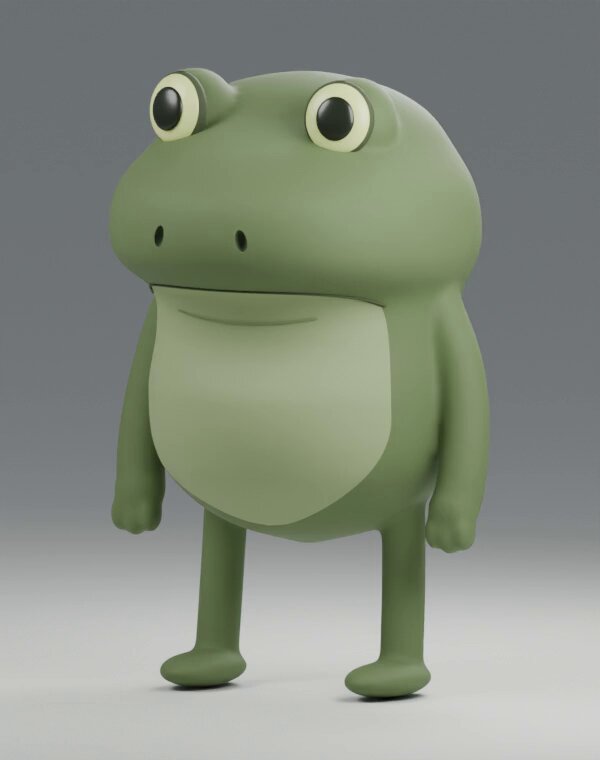
Thumbnail from Patrick's public standing-Bufo clip. This is the accepted character, not a capture of the private turntable revisions. Select it to watch the video.
The feedback here is different from asking an image generator for "another frog, but better." Each fix only showed up from a particular angle. The front view could pass while the profile failed. A snout that looked right from the side could look too sharp from three-quarters. The back mattered too, because a shape that only exists for the camera isn't much use once the camera moves. Patrick kept asking for more angles until they all agreed.
Making him move
The v6 model was still a sculpt. It could stand there. It could not blink, cough, or scratch anything. The next step was a skeleton, so parts of the body and face could move without tearing the character apart.
The first animation was a small idle loop: some breathing, a weight shift, and a blink. The output included an editable Blender scene, an animated 3D file, and video and GIF previews. It's the Bufo just standing there clip, and it does what it says.
Then Patrick asked for something more specific: Bufo coughs into his hand, scratches his butt, and goes back to resting.
An early version exposed a new gap. Bufo's body coughed, but his mouth didn't open. The static model had never needed a mouth that moved, so nobody had noticed it couldn't. The model and animation were revised so the mouth could open too. Patrick posted an eight-second version on X.
This is the same lesson as the turntable, in a new place. Rotating the model caught problems a single render hid. Animating it caught problems the turntable hid. Every new thing Patrick asked Bufo to do tested a part of him that hadn't been tested yet.
From there Patrick kept going with short reactions: a scream, a stab, a run, a hug, and others. Some were exported at small reaction sizes, so a pose had to read in a tiny image as well as a full render. A worried frog at emoji size doesn't have many pixels to be worried with.
Not everything landed the first time. The first scream was basically a jitter, until Patrick spelled out where the head should point and how the body should shake. In another clip the arms looked wrong and needed another pass. But these were corrections to work he was enjoying, not signs that the approach had stalled. Overall he thought Astra was very good at taking a reference character and a short, contained action and turning them into an animation that worked.
The rest of the X thread shows how many variations came out of one model. That's the practical difference from the first render. Bufo was no longer a picture that had to be regenerated from scratch each time. He was a character Patrick could pose, rotate, and drop into a new action without an image generator reinventing his face. The public posts are as far as that goes for now. There's no evidence yet that the model or clips were used anywhere else.
The bush
One of Patrick's favorites is bufo bush. He gave Astra a reference GIF to follow, and the result is five seconds long.
The camera holds still. Bufo shuffles backward in small steps, slides behind the leaves until he's gone, and then the clip just sits on the empty bush for a beat. The empty bush is the joke. The timing makes it land.
Patrick thinks Astra nailed the camera angles and the result. It's also a good example of what worked across the whole experiment: a known character, a short action, a clear reference, and a single idea the clip has to deliver.
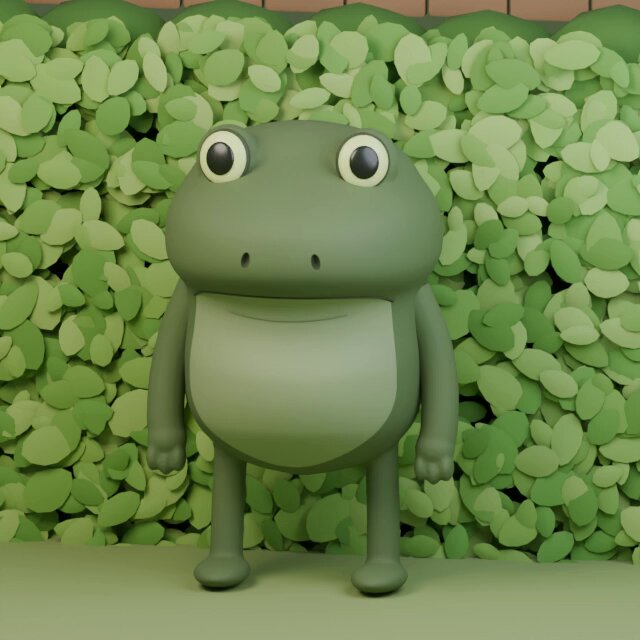
Thumbnail from Patrick's public bush clip. Select it to watch Bufo back out of view. The still does not show the motion or timing.
Where it stopped working
Then Patrick tried something much bigger: a full-length Bufo version of the Rick Astley music video.
Getting it to render took real work. The first cut had a generic, repeating mouth motion that didn't follow the vocals. Patrick caught that, and the agent made a short vocal-timed test to fix the lip sync. Then he noticed the clothes looked painted onto Bufo's body. The agent built separate, rigged clothing for him. The final rerender ran through thousands of frames, stopped before it finished encoding, and was eventually completed as a video file.
So a finished file exists. Patrick didn't post it, because in his judgment it wasn't good enough.
The original video changes scenes constantly and has a lot of movement. The Bufo version fell back on a basic set of scenes and repeated them. The agent tried to fix the mouth and clothes, but the result didn't capture what makes the original fun to watch. It was a complete render of a mediocre music video.
That makes it a second version of the gap from the beginning. The first mesh existed as a 3D file and still wasn't a usable model. The music video existed as a video file and still wasn't a good performance. Both times, the agent's output looked done before it was right, and it took Patrick looking at the thing itself to see it.
What came out of it
Patrick started with a few reference images and no 3D experience. He ended up with a Bufo he could turn around, recognize from every side, and animate in Blender, plus a handful of short clips he liked enough to post.
The corrections along the way followed a pattern. The turntable caught what a single render hid: floating eyes, a flat profile, a snout that was too sharp. Animation caught what the turntable hid: a mouth that didn't open, a scream that was only a jitter. Each new way of looking at Bufo tested something the last one couldn't.
The music video marked the limit. Astra did a lot with a known character and a short, contained action. A full song with changing scenes and constant movement asked for much more than a character model and a few good reaction shots. The rendering finished. The video wasn't good.
The part worth sharing is the short clips. The bush one especially.