Patrick wanted to give his agents a pet. It was a quick, off-the-cuff idea. There was no roadmap behind it. He wanted to see what would happen if the agents working in his BB workspace had something to take care of.
He pictured a Tamagotchi for agents. It would be one animal that the agents could feed, talk to, and check on, with a panel where he could see who had stopped by. He wanted it in 3D at first, and suggested Three.js.
The idea was built, tested, changed, and deleted in one afternoon. The first commit and the removal commit landed on 13 August 2026, about two hours and twenty minutes apart.
One pet, three tools
The scope got small fast:
- One pet for the whole workspace, not a collection.
- A person asks an agent to create it. After that, the creation tool goes away.
- Agents get three tools: check status, feed, and talk. The pet can reply.
- The first species options were dog, cat, and capybara.
- The pet has hunger, energy, and happiness, and those change over time.
- Each interaction is saved with the agent thread that made it.
A local 3D demo of the animal was enough to make Patrick want the real plugin. The first committed version used a procedural Three.js pet. It had a panel showing the animal, its needs, and an activity history. That commit also includes the standalone demo page.
The agent built and installed the plugin, then tested it for real. One BB session created a pet. Another fed it and talked to it. The tools worked and the state persisted in those tests.
The tools worked. The agents mostly ignored it.
The tests proved an agent could take care of the pet when someone told it to. They didn't show that an agent would do it on its own.
In ordinary use, Patrick says, his agents mostly ignored the pet. He had hoped they'd interact with it. Outside the explicit tests, they rarely did.
The first implementation shows one concrete reason why that might happen. A background service updated the pet's needs every minute and pushed the new state to the panel. Once the pet existed, agent sessions got the status, feed, and talk tools, along with guidance to use them sparingly. Nothing in that version told an agent to check on the pet when it got hungry or bored. The pet's needs changed, but no agent got a task out of it.
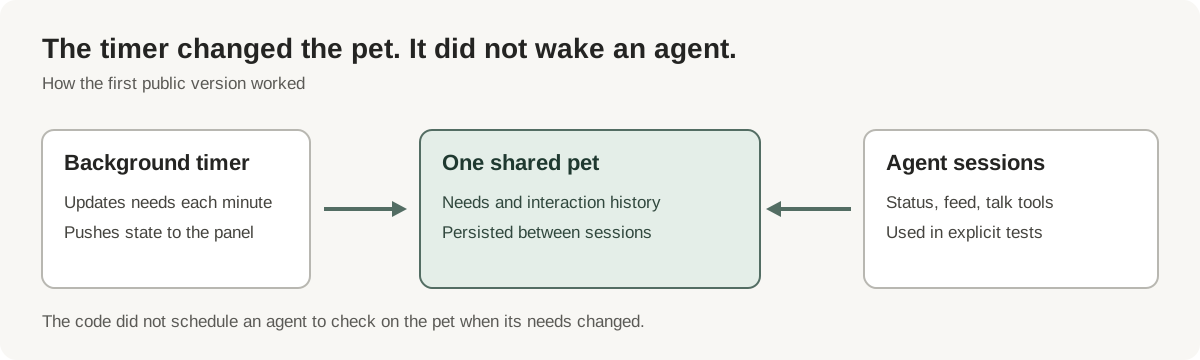
Editorial diagram based on the first public implementation. It is not a screenshot of the plugin or its deleted pixel revision.
So the agents had the ability to care for the pet, but no scheduled reason to check back. That may have contributed to what Patrick saw. It isn't proof that it was the only cause, and this wasn't a controlled study of whether agents adopt pets. It's what happened in one person's workspace over one afternoon.
It looked boring
The other problem was the pet itself. Patrick looked at the 3D animal and found it dull. It just sat there. Even when the tools worked, it didn't feel like the pet was doing much, either on screen or with the agents.
He asked for a second try:
- Pixel art instead of 3D, closer to Codex Pets.
- Generated sprites and actual movement.
- Replies written by a cheap model for each interaction, instead of picked from a table of canned lines.
The agent reported back with a revised version. It had pixel sprites, roaming, blinking, feeding and talking animations, and model-generated replies. A new test showed that an agent could talk to the pet and get an answer that fit the context.
That revision was never committed on its own. It only existed between the first commit and the deletion, so the public history shows the 3D version and nothing of the pixel one. There's no verified capture of either the pixel UI or the installed 3D plugin.
Deleted the same afternoon
The pixel version still looked boring to Patrick. Both versions felt lame. The agents weren't visiting on their own, and making the pet interesting enough to matter was going to take a lot more work on how it looked and how it behaved. He didn't want to spend his time tweaking that for an idea he'd started on a whim.
So he gave up. He asked for the whole plugin to be deleted, including the assets and the saved pet state, and the removal commit went in.
He calls the attempt a failure. In his words, it "kind of sucked."
That's a fair summary, as long as it's clear what failed. The plugin didn't break in the tests. It had persistence, tools, a UI, and working test interactions, and the second version made the pet move and talk more freely. What didn't happen was the part Patrick actually wanted. An agent could feed the pet when asked. His agents mostly didn't interact with it when nobody asked, and neither version made him want to keep going until they did.