The Quantization Conspiracy Theory
Guest writers
There's a ridiculous theory floating around on places like Reddit and Twitter that greedy model companies are selectively dumbing down their models for some profit motive. Typically these conspiracy theories focus on models getting dumber over time, or during peak periods, and the way model companies are doing this is through "quantization".
Nevermind the novelty factor of the models wears off over time, no, its the greedy companies trying to extract more profit from users!

Let's talk about this.
What is quantization
Quantization[1] is the process of truncating model weights to obtain a smaller (and consequently faster running) model. Typically quantization will trade off model intelligence for a reduction in utilization of expensive gpu memory and also require less computation during inference. You can take a model that's been trained with FP16 or FP32 (Floating Point 16/32 Bits), chop off some bits and the models will continue to work pretty well. If you're interested in a deeper dive on model inference, check out this blog post in model inference speed of light calculations[2].
The arguments
Some redditors discuss chat gpt quality issues
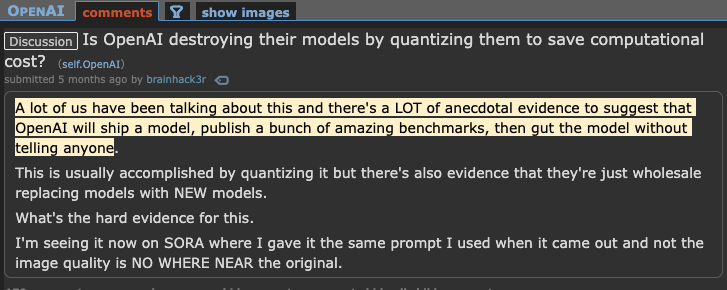
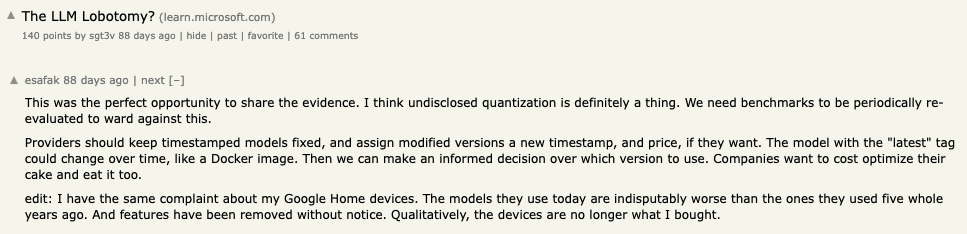
Hacker news commentor
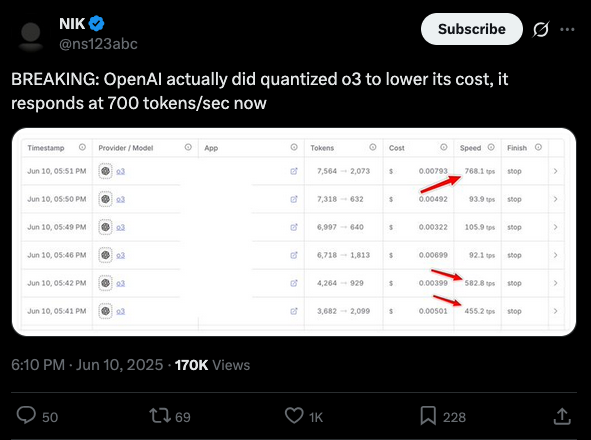
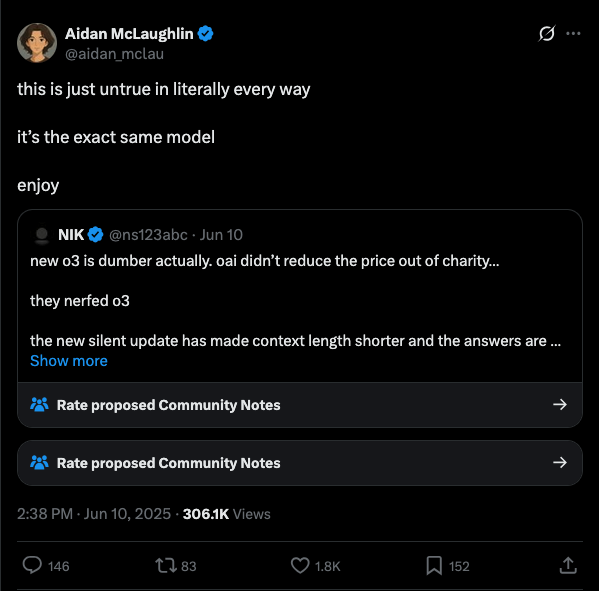
Twitter user with subsequent response from an OpenAI employee
Users on Reddit complain about claude code
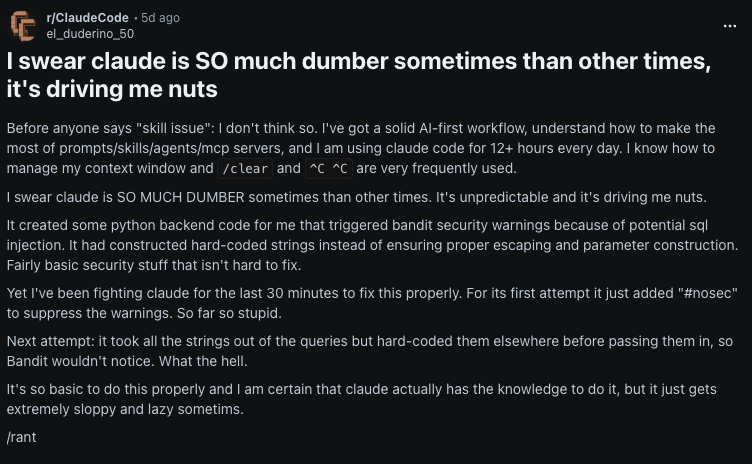
Are model companies quantizing their models?
Yes, most likely! It's an easy way to get performance gains from a model you already have, improving inference speed and reducing the amount of GPU resources you need for inference.
Are model companies quantizing their models after release?
Their models, no. Their products, maybe.
You need to break down model providers into two groups:
- Big labs (OpenAI, Anthropic, Google, Mistral, etc)
- Open source model hosts (Together.ai, fireworks.ai, etc)
This post will only cover big labs, not open source model hosts. Most of the complaints revolve around OpenAI and Anthropic.
The big labs typically offer a chat product (including coding products) and an API. Each are tailored to different use cases. Chat products like ChatGPT are targeted towards your average consumer, while APIs are typically targeted to business customers and developers.
APIs
A company like OpenAI typically releases a model under a name like gpt-5.2 and will typically also release specific versions of models like gpt-5.2-2025-12-11. The expectation is that model names like gpt-5.2 will be updated as they improve the model, whereas specific model versions like gpt-5.2-2025-12-11 won't change (and will be deprecated faster).
If OpenAI decided to try to pull a fast one over on their customers by "rug pulling" model quality on their API after release, their customers would find out almost immediately.
Consumers of these APIs are usually building products with the models. When you're building a product that uses a black box like a LLM, and you want to ensure the quality of your product is stable, you build an evaluation[3] dataset and run it against your product anytime you change something. With all these customers running evaluations against these models constantly, its impossible that a performance impact will go unnoticed. Any attempts to sneakily implement cost cutting measures will be caught red-handed. A bump in model version could affect evaluation scores, and OpenAI has provided guidance in the past to pin your model version.
The other sure sign would be a sudden and abrupt increase of model response speed across the board. If you change the size of the model that you're serving, you will change the inference speed of the model output. If you take a large model, then cut the weights in half by quantization, you would see a corresponding speed increase due to the lower computation cost. This would be a consistent improvement, but also only tangential evidence. You could also improve inference speed by optimization to the inference software stack (like kernel fusion [4]).
"Oh they could be tricking you somehow by quantizing it and then just adjusting the speed they return the tokens to you!" -> That's seriously ridiculous. They're going to invest the time and infrastructure to build out some kind of system that will drip feed you tokens after? Seriously? Could you build a system to do this? Sure, probably. Would they do it? No. These companies leak like a sieve. If they tried doing that, it would be public pretty quickly.
So let's put API offerings aside and assume that the big labs won't mess with their biggest source of revenue.
Chat Products & Agents
So that leaves the products including chat bots and agents like codex and claude code. Are the companies sneakily quantizing models here?
They probably aren't dynamically quantizing models, but they may change the models used for the experiences!
ChatGPT rolled out their model router with ChatGPT5 which people hated. This router was able to dynamically allocate a user's request to different models. I have no doubt that OpenAI built in measures into this system to be able to dynamically control the flow of traffic to different models, especially with all the free user traffic they receive.
Does this mean that OpenAI was sneakily taking a model then quantizing it after users get used to the powerful version while rubbing their sneaky hands together?
No, however it does mean that they're able to dynamically scale up or down different models and route traffic to them based on current system load. This could potentially result in a different user experience for users that get routed to different models. Also, just because a user is routed to a different model doesn't mean they're getting a "quantized" model. There are many different ways to reduce inference cost including just using a model with fewer parameters, or different architectures (sparser mixture of expert models), speculative decoding, etc. Quantization is just one tool in a researcher's toolkit to reduce resource usage.
Another complaint is that Claude Code gets dumber at certain times. Anthropic did confirm an incident where there were several issues that caused a regression, so that's a possible explanation during that time. Another potential explanation could be context overload[5] where the model's context fills up which the model cannot handle well (even though they say the context is of a certain length).
Intent
The general sentiment around AI companies has been prety sour. I get it, they promised a lot of bullshit and its a really bad look. However, I don't think they're trying to screw over Joe Schmoe by rug pulling them with a dumber model after release. I also specifically think that this idea that these companies are using quantization as the only tool in their belt to reduce GPU usage is ridiculous. If it smells like a conspiracy theory, sounds like a conspiracy theory, then it probably is a conspiracy theory.
What I do think is happening is two-fold:
- The technology becomes normalized. People just get used to the thing and the novelty factor wears off. They now start seeing the flaws and are disappointed.
- The companies are trying to optimize their product to be more resource efficient trading off product quality when it makes sense. I don't actually think this is a bad thing either, it's engineering. There is always a tradeoff and you do the best you can to provide the best product you can. I don't think they're doing it by sneaking around rug pulling users though.
What I'm pretty sure isn't happening:
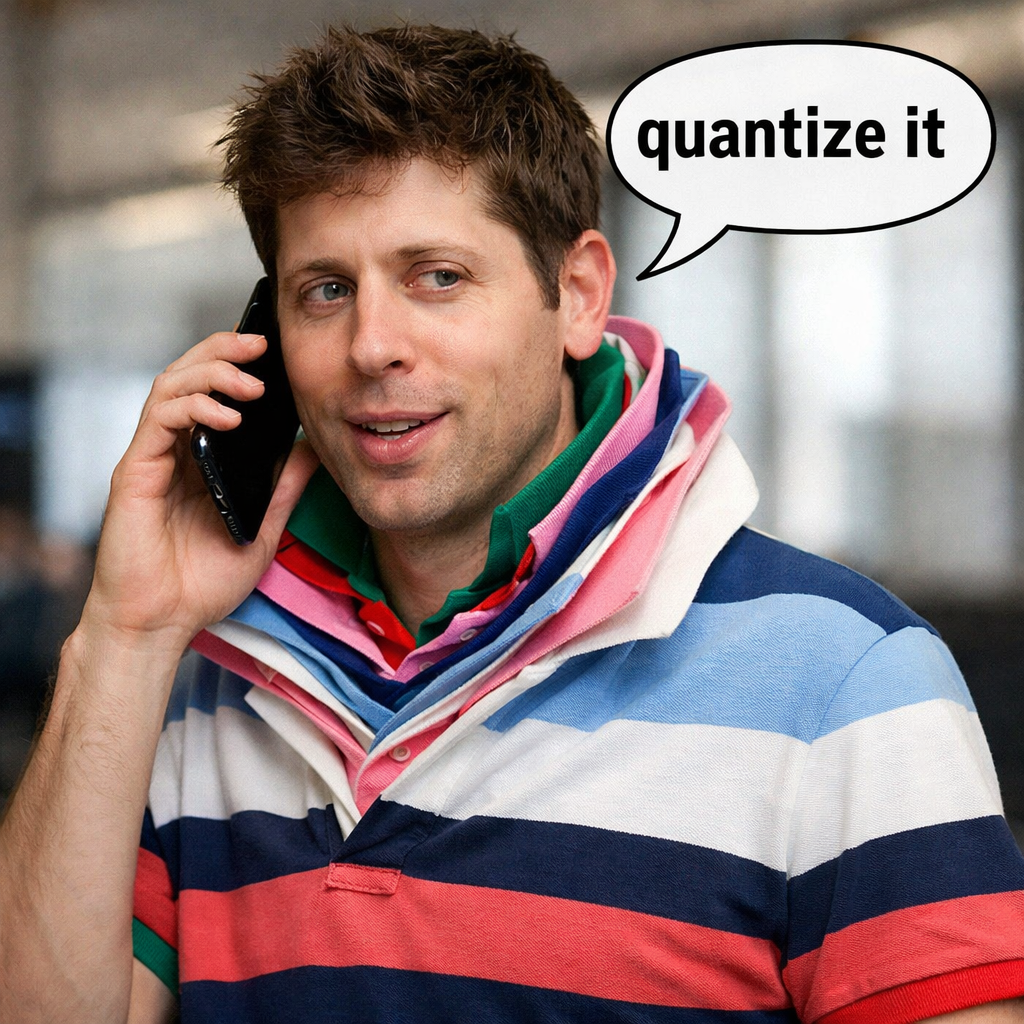
-
The big labs aren't releasing a model then heavily applying quantization after-the-fact. They spend a lot of time and energy training the model, then evaluating their checkpoints to pick the one that performs the best. This process usually includes other inference optimization techniques they may apply to achieve the desired traits from the model (like quantization, speculative decoding, or other inference time improvements). They then release the model, and it goes out into the world as a version. They may make updates to the model, additional training or fixing issues that arise. They most likely release these as new versions of under the same model banner.
-
They aren't sitting around rubbing their hands trying to screw you out of your tokens. They have a high demand product, limited resources, and are just trying to build a good product for the most part.
-
Quantization isn't the only tool they have for model performance. Anytime discourse around model quality comes up, "quantization" always comes up like it's some big gotcha. By throwing around quantization, you're really not helping your case! If there are model quality issues, then talk about the model quality instead of coming up with conspiracies about how they're stealing your tokens.
Why did I write this?
A comment I received
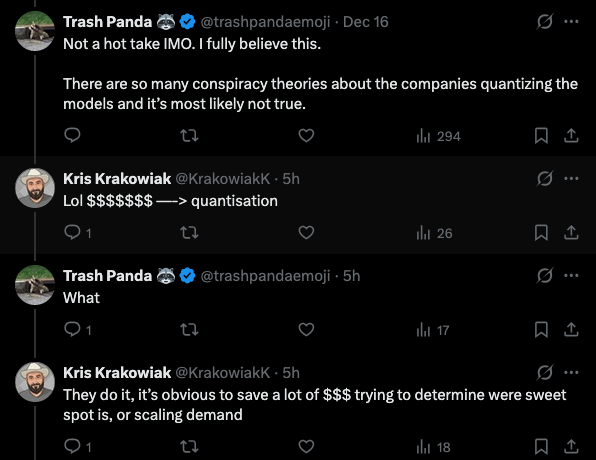
I've been seeing this discourse for a while now and its been bothering me. I get the frustration when you use a product and you feel like its getting worse over time. I think its human nature to want to speculate about why it happens, and I just so happen to be a bit of an expert in this area, so it rubs me the wrong way.
Three things to take away from this:
- Yes, there could be quality issues with these products. Regressions do happen, and these companies are constantly changing things an optimizing to improve resource utilization.
- No, they aren't doing this to screw you over or for some profit motive (yet), and they aren't applying quantization to a new model after-the-fact to bait and switch you.
- Quantization isn't just some hammer to bash models with, these are large, complex systems and other things could also affect product quality.
Footnotes
For a deeper dive into quantization, I recommend reading this page on hugging face ↩︎
Evaluations are test sets where you keep example inputs and outputs and you test your system against to ensure quality has not changed when you make changes to your system. Anybody seriously building products will have evaluations, it's a fact of life when trying to maintain a consistent product. ↩︎
Kernel fusion is a technique that optimizes the software running on the GPU that takes into account GPU architecture to run calculations more efficiently. See Andrej Karpathy's video for a good explanation of kernel fusion ↩︎
Dex Horthy's talk on context management is very interesting. A rule of thumb is that models get dumb when around half their context fills up: https://www.youtube.com/watch?v=rmvDxxNubIg ↩︎
Are model companies quantizing their models?
Yes, most likely! It's an easy way to get performance gains from a model you already have, improving inference speed and reducing the amount of GPU resources you need for inference.
Quantization is the process of truncating model weights to obtain a smaller and faster running model. This trade-off typically results in a reduction in model intelligence but also requires less computation during inference.
The arguments
Some people on platforms like Reddit and Twitter have been discussing the quality of models getting worse over time, or during peak periods, and how model companies are doing this through quantization. They believe that this is a profit-driven motive for companies to extract more profit from users.
Quantization explained
Quantization is the process of reducing the precision of model weights to obtain a smaller and faster running model. It involves chopping off some bits from a model that has been trained with FP16 or FP32 (Floating Point 16/32 Bits). This allows the model to continue working well while using less expensive GPU memory and requiring less computation during inference.
Are model companies quantizing their models after release?
Their models, no. Their products, maybe.
There are two types of model providers: big labs and open source model hosts. This post will focus on big labs, such as OpenAI and Anthropic, who typically offer both chat products and APIs. Chat products are targeted towards average consumers, while APIs are typically targeted towards business customers and developers.
APIs
A company like OpenAI usually releases a model under a name like gpt-5.2 and also releases specific versions of models like gpt-5.2-2025-12-11. These models are evaluated and the one that performs the best is released. The company may make updates to the model, such as additional training or fixing issues, and release these as new versions under the same model name.
The conspiracy theories
Some people believe that model companies are intentionally making their models dumber over time in order to increase their profits. They point to examples of users complaining about model quality issues and attribute them to quantization.
The truth
The truth is that quantization is just one tool that companies have for improving model performance. They also have other techniques such as kernel fusion and context management. These companies are constantly optimizing their products and may make changes that affect model quality. However, there is no evidence to suggest that they are intentionally making their models worse for profit.
Why did I write this?
As an expert in this field, it bothers me to see people spreading false information about model companies. I understand the frustration when a product seems to be getting worse over time, but it is important to have a deeper understanding of the situation before making accusations. Quantization is a common technique used in many industries, and it is not a malicious tool used to scam users out of their tokens.
Conclusion
Quantization is a legitimate technique used by model companies to improve performance and reduce resource usage. While there may be instances where model quality is affected, there is no evidence to suggest that companies are intentionally making their models worse for profit. It is important to have a deeper understanding of the situation before making accusations and spreading false information.
The "Greedy AI Companies Are Quantizing Models" Conspiracy Theory
There's a ridiculous theory floating around Reddit and Twitter: greedy model companies are selectively dumbing down their models for profit. The claim is that models get dumber over time, or during peak periods, through sneaky "quantization."
Nevermind that the novelty factor wears off. No, it must be greedy companies extracting profit from users.
Let's talk about this.
What Is Quantization?
Quantization[1] truncates model weights to produce smaller, faster models. You trade intelligence for reduced GPU memory usage and lower computation costs during inference. Take a model trained with FP16 or FP32, chop off some bits, and it still works pretty well. For a deeper dive on model inference, check out this post on inference speed of light calculations[2].
The Arguments
Redditors discuss ChatGPT quality issues:
Hacker News weighs in:
Twitter speculation with an OpenAI employee response:
Reddit complaints about Claude Code:
Are Model Companies Quantizing Their Models?
Yes, most likely. It's an easy performance win—faster inference, lower GPU costs.
Are They Quantizing After Release?
Their models, no. Their products, maybe.
This post focuses on big labs (OpenAI, Anthropic, Google, Mistral), not open source model hosts. Most complaints target OpenAI and Anthropic anyway.
Big labs offer two things: chat products (including coding tools) and APIs. Chat products target consumers. APIs target businesses and developers.
APIs
OpenAI releases models under names like gpt-5.2 alongside specific versions like gpt-5.2-2025-12-11. The general name gets updated over time. The specific version stays frozen until deprecation.
If OpenAI tried to rug-pull API quality, customers would catch it immediately.
API consumers build products on these models. When your product depends on a black box LLM, you build evaluation datasets[3] and run them constantly. With thousands of customers running evals against these models, performance regressions can't hide. Any sneaky cost-cutting gets caught red-handed.
The other telltale sign would be sudden, abrupt speed increases across the board. Quantize a model and inference speed jumps due to lower computation costs. This would be consistent and noticeable—though speed improvements could also come from inference stack optimizations like kernel fusion[4].
"They could drip-feed tokens to hide the speed increase!" Seriously? They're going to build infrastructure to artificially slow down responses? Could you build such a system? Sure. Would they? No. These companies leak like sieves. It would go public fast.
Let's put APIs aside. Big labs won't mess with their biggest revenue source.
Chat Products and Agents
That leaves chatbots and agents like Codex and Claude Code. Sneaky quantization here?
They probably aren't dynamically quantizing models, but they may change which models serve the experience.
ChatGPT rolled out model routing with ChatGPT5. People hated it. The router dynamically allocates requests to different models. OpenAI almost certainly built controls to manage traffic flow, especially for free users.
Does this mean OpenAI sneakily quantizes models after users get hooked on the powerful version?
No. But they can dynamically scale and route traffic based on system load. Different users might hit different models, creating inconsistent experiences. That's not the same as quantization. There are many ways to reduce inference cost: fewer parameters, sparser mixture-of-experts architectures, speculative decoding. Quantization is one tool among many.
Another complaint: Claude Code gets dumber at certain times. Anthropic confirmed an incident with several issues causing regressions. Another explanation: context overload[5], where the model's context fills up and performance degrades—even within advertised context limits.
Intent
Sentiment around AI companies is sour. They promised a lot of bullshit and it's a bad look. But I don't think they're trying to screw over Joe Schmoe by rug-pulling model quality. The idea that quantization is their only cost-reduction tool is ridiculous. If it smells like a conspiracy theory and sounds like one, it probably is.
What I think is actually happening:
- Normalization. People get used to the technology. Novelty wears off. Flaws become visible. Disappointment follows.
- Resource optimization. Companies trade off product quality when it makes sense. This is engineering. Tradeoffs are inevitable. I don't think they're sneaking around to do it.
What I'm pretty sure isn't happening:
-
Big labs aren't releasing models then heavily quantizing them after the fact. They spend enormous effort training and evaluating checkpoints. Inference optimizations (including quantization, speculative decoding, etc.) happen before release. Updates ship as new versions under the same model banner.
-
They aren't rubbing their hands together trying to steal your tokens. They have high-demand products, limited resources, and are mostly just trying to build something good.
-
Quantization isn't their only tool. Every time model quality comes up, "quantization" gets thrown around like a gotcha. You're not helping your case. If there are quality issues, talk about quality—not conspiracy theories about stolen tokens.
Why I Wrote This
A comment I received:
This discourse has been bothering me. I understand the frustration when a product feels worse over time. Speculation is human nature. I happen to know this area well, so the bad takes rub me the wrong way.
Three takeaways:
- Quality issues exist. Regressions happen. Companies constantly change things to optimize resource utilization.
- They aren't doing this to screw you over or for profit motives (yet). They aren't quantizing new models after release to bait and switch you.
- Quantization isn't a hammer for bashing models. These are large, complex systems. Many factors affect product quality.
For a deeper dive into quantization, I recommend reading this page on Hugging Face. ↩︎
Evaluations are test sets with example inputs and outputs. You run your system against them to ensure quality hasn't changed. Anyone seriously building products has evaluations. ↩︎
Kernel fusion optimizes GPU software by accounting for architecture to run calculations more efficiently. See Andrej Karpathy's explanation. ↩︎
Dex Horthy's talk on context management is excellent. Rule of thumb: models get dumb when around half their context fills up. https://www.youtube.com/watch?v=rmvDxxNubIg ↩︎
The Quantization Conspiracy: Are AI Labs "Dumbing Down" Models?
A persistent theory is circulating on Reddit and X: AI companies are selectively lobotomizing their models to save on compute costs. The culprit, according to the armchair experts, is "quantization"—a process allegedly used to bait-and-switch users with high-quality models at launch, only to rug-pull them with "dumber," cheaper versions later.
Let’s look at why this narrative, while grounded in real user frustration, fundamentally misunderstands how these systems are built and served.
What is Quantization?
Quantization is the process of truncating model weights (e.g., from FP32 or FP16 to INT8 or INT4) to create a smaller, faster model. It trades a marginal amount of "intelligence" for significant reductions in VRAM usage and increased inference speed. It is a standard industry practice, not a secret cost-cutting heist.
The Evidence (or Lack Thereof)
Users frequently cite perceived quality drops in ChatGPT or Claude as proof of post-release quantization.
While the frustration is real, the "secret quantization" theory falls apart when you look at how major labs operate.
1. The API Reality
For labs like OpenAI and Anthropic, the API is the primary revenue driver for enterprise clients. These customers run rigorous evaluation (eval) datasets against specific model versions (e.g., gpt-4-0613). If a lab "stealth-quantized" a pinned version, thousands of automated benchmarks would flag the regression instantly.
Furthermore, quantization drastically changes inference speed. If a model suddenly doubled its tokens-per-second overnight without an architectural announcement, it would be obvious. The idea that labs would build additional infrastructure to "throttle" quantized models just to hide the speed gain is a logistical absurdity.
2. Chat Products and Routing
Where the theory gets closer to the truth is in consumer-facing products like ChatGPT or Claude. These aren't just single models; they are complex systems.
Labs use model routers to manage load. During peak traffic, a router might direct a request to a smaller, more efficient model or a different architecture (like a MoE variant). This isn't "stealth quantization" of your favorite model; it’s dynamic load balancing.
If Not Quantization, Then What?
If you feel your model is getting "dumber," several factors are more likely than a secret weight-chopping conspiracy:
- Novelty Decay: The "wow factor" wears off, and users begin to notice edge-case flaws that were always present.
- Context Overload: As conversations grow, models struggle with "middle-of-the-context" retrieval. Performance often degrades once a buffer is half-full.
- System Prompt Drift: Small changes to the hidden instructions (system prompts) used to steer safety or personality can have outsized effects on reasoning capabilities.
- Actual Regressions: Software is hard. Anthropic, for instance, recently confirmed that specific technical issues caused a genuine regression in Claude’s performance.
The Bottom Line
Model companies are not sitting in dark rooms rubbing their hands together, looking for ways to steal your tokens. They are struggling to balance unprecedented demand with finite GPU resources.
Quantization is a tool used during the deployment phase to optimize a model for its entire lifecycle—it isn't a dial they turn up and down on a Tuesday afternoon to save a few pennies.
If a product feels worse, criticize the quality and demand better evals. But let’s leave the "stealth quantization" conspiracies on the forums. Engineering involves trade-offs; those trade-offs are usually documented, measurable, and far more boring than a conspiracy.
The "Greedy AI Companies Are Dumbing Down Models" Conspiracy—Debunked
The internet loves a good conspiracy theory, and few are as persistent (or as ridiculous) as the claim that AI companies are intentionally degrading their models to squeeze more profit from users. The usual suspects—Reddit, Twitter, and Hacker News—are awash with complaints that models like ChatGPT or Claude are "getting dumber over time" or during peak usage, all because of some shadowy corporate plot involving quantization.
Let’s cut through the noise.
What Is Quantization?
Quantization is the process of reducing the precision of a model’s weights—typically from FP16 or FP32 (16- or 32-bit floating point) to lower-bit representations (e.g., INT8, INT4). The result? A smaller, faster model that consumes fewer GPU resources during inference.
- Trade-off: Lower precision usually means slightly reduced performance, but the gains in speed and efficiency often outweigh the losses.
- Not a new trick: Quantization has been a standard optimization technique in ML for years. It’s not some dark pattern—it’s just engineering.
If you want a deeper dive into how quantization (and other inference optimizations) work, this post on LLM inference speed is a solid read.
The Conspiracy: Are AI Companies Quantizing Models After Release?
Short answer: No. But let’s break it down.
1. API Models: No, They’re Not Rug-Pulling You
Big labs (OpenAI, Anthropic, Google, Mistral, etc.) serve two main audiences:
- Consumers (via chat interfaces like ChatGPT or Claude)
- Developers (via APIs, where businesses build products on top of LLMs)
Why APIs Are Safe from Sneaky Quantization
- Versioned models don’t change. When OpenAI releases
gpt-5.2-2025-12-11, that version is locked. If they quantized it post-release, their enterprise customers—who run constant evaluations on their models—would notice immediately. - Speed bumps = red flags. If a model suddenly runs faster due to quantization, it’s obvious. (And no, they’re not "drip-feeding" tokens to fake slowness—that’s absurdly complex for zero gain.)
- Optimizations happen before release. Labs apply quantization (and other inference tricks like speculative decoding or kernel fusion) during training/evaluation, not after. The best checkpoint gets picked, optimized, and shipped. End of story.
What Could Happen (But Isn’t a Conspiracy)
- Dynamic routing. OpenAI’s model router (e.g., for ChatGPT-5) can direct users to different models based on load. If you’re routed to a lighter model, it might feel dumber—but that’s not quantization, just a smaller model.
- Context overload. Models degrade when context windows fill up. Dex Horthy’s talk on context management explains why this happens (and it’s not malice—it’s physics).
2. Chat Products: Not Quantization, Just Optimization
The real grievance? Chat interfaces do change over time—but not because of some evil quantization plot.
Why Chat Products Feel "Dumber"
- Novelty fade. The "wow" factor wears off. What once felt magical now feels… meh. That’s not a bug; it’s human psychology.
- Resource constraints. Free tiers get throttled. Paid users get better models. This isn’t a conspiracy—it’s how SaaS works.
- Actual regressions. Sometimes, models do get worse. Anthropic admitted to a Claude Code incident that caused a dip in performance. But that’s a bug, not a feature.
What Companies Are Doing (And It’s Fine)
- Trading quality for efficiency. If a model is 95% as good but 3x cheaper to run, that’s a no-brainer for a business. (Would you rather pay $0.01 or $0.03 per token for 95% of the quality?)
- Using smaller models for free users. Not quantizing—just serving a lighter model. Again, standard practice.
- A/B testing. Sometimes, changes roll out gradually. If a new model sucks, they’ll roll it back. (Yes, even AI companies do QA.)
The Real Reasons Behind the Hype
What’s Actually Happening
- The honeymoon phase is over. Early adopters experienced the "peak" of a model’s capabilities. Now, they’re seeing the rough edges.
- Companies are optimizing for scale. More users = more cost pressure. Trading some quality for efficiency is rational.
- Quantization is a scapegoat. People latch onto it because it’s technical-sounding, but it’s rarely the real issue. If a model feels worse, blame:
- Context limits (too much text in the window)
- Temperature/decoding tweaks (more deterministic = less "creative")
- Model swaps (you’re not talking to GPT-4 anymore; you’re talking to GPT-4-Turbo-Lite)
What’s Not Happening
❌ Post-release quantization rug pulls. (They’d get caught in hours.)
❌ Evil profit-maximizing schemes. (They’re already printing money.)
❌ Quantization as the only optimization tool. (It’s one of many—speculative decoding, distillation, pruning, etc., all play a role.)
Why This Matters
A commenter once asked me:
"Why do people keep pushing this quantization conspiracy?"
Because frustration needs a villain. When a product feels worse, it’s easier to blame a shadowy corporate plot than to accept that:
- Tech improves, then plateaus. (The iPhone 15 isn’t that much better than the iPhone 13.)
- Free tiers are free for a reason. (You’re not the customer; you’re the product.)
- Optimization is inevitable. (Every company cuts costs where it can.)
Key Takeaways
- Yes, models can regress. Bugs happen. Context windows fill up. Companies iterate.
- No, they’re not quantizing models post-release to screw you. That’s technically possible but logistically stupid.
- Quantization is just one tool. If a model feels worse, dig deeper—don’t default to conspiracy.
- The real issue? Expectations. AI hype cycles are brutal. What felt revolutionary in 2022 now feels… adequate.
Further Reading
Debunking the "Quantization Conspiracy" in AI Models
A persistent conspiracy theory claims AI model companies are secretly "dumbing down" their models via quantization to cut costs—ignoring the novelty effect and blaming greed instead. Let’s dissect this.
What is Quantization?
Quantization truncates model weights to reduce size, speed, and GPU memory usage. It trades minor intelligence loss for efficiency, converting FP16/FP32 models to smaller formats. This is standard practice, not a hidden trick.
The Arguments: User Complaints
Users cite quality drops in ChatGPT, Claude Code, and other products. Examples include Reddit threads, Hacker News comments, and Twitter exchanges (e.g., OpenAI employees denying quantization). These anecdotes fuel the theory—but anecdotes aren’t evidence.
Are Companies Quantizing Models?
Yes, but not as a post-release bait-and-switch. Quantization is a legitimate optimization. The real question: When and where?
Big Labs vs. Open Source Hosts
Focus on big labs (OpenAI, Anthropic, Google) since most complaints target them. They offer two products:
- Chat products (e.g., ChatGPT, Claude Code): Consumer-facing.
- APIs: Business/developer tools.
APIs: Unlikely to Be Quantized Post-Release
API users (developers) run constant evaluations. A sudden quality drop would trigger red flags. OpenAI’s versioned models (e.g., gpt-5.2-2025-12-11) are immutable; changes require new versions. Quantization would also boost inference speed—an observable metric. Claims of "token drip-feeding" are absurd: infrastructure costs and leaks make this impractical.
Chat Products: Model Routing, Not Secret Quantization
Chat products use model routers (e.g., ChatGPT5) to allocate traffic dynamically. This optimizes load, not necessarily quantization. Routers might route to smaller models (e.g., fewer parameters) or use techniques like speculative decoding—not post-release quantization. Claude Code’s regressions? Anthropic confirmed incidents (e.g., context overload), not quantization.
The Reality: Normalization and Optimization
Two factors explain perceived quality drops:
- Novelty wears off: Users now notice flaws they ignored initially.
- Legitimate optimization: Companies trade minor quality for efficiency (e.g., model routers, sparser architectures). This is engineering, not deception.
What Isn’t Happening
- Post-release quantization: Labs invest heavily in training; quantization is part of the release process, not an afterthought.
- Greedy "screwing over" users: High-demand products and limited resources drive optimization, not malice.
- Quantization as the sole tool: Other techniques (e.g., kernel fusion, context management) impact quality. Blaming quantization alone is misdirection.
Why This Matters
Frustration with AI products is valid, but conspiracy theories distract from real issues. Quality regressions happen, but they stem from engineering tradeoffs, not secret schemes. Focus on observable metrics (e.g., evaluation scores, inference speed) instead of unfounded claims.
Key Takeaways
- Quality issues exist: Regressions occur, but they’re often due to optimization or context limits.
- No post-release quantization: Labs prioritize transparency in APIs; chat products use routers, not hidden tricks.
- Quantization is one tool: Complex systems involve multiple optimizations—don’t oversimplify.
The "quantization conspiracy" is a red herring. The real story is about balancing performance, cost, and user experience—standard engineering, not greed.
Debunking the Quantization Conspiracy: Are AI Companies Dumbing Down Models For Profit?
A persistent conspiracy theory circulating on Reddit, Twitter, and other platforms claims that AI companies are secretly degrading their models using quantization for profit. Let’s dissect this claim.
What is Quantization?
Quantization is a technique used to reduce the precision of a model’s weights, shrinking model size and speeding up inference. It trades a minor dip in performance for significant gains in efficiency. For example, reducing weights from FP32 to FP16 cuts memory usage in half.
The Conspiracy Claim
The theory goes like this: companies are quantizing their models post-release to cut costs, making them dumber to save on GPU resources. Users report erratic performance, especially during peak usage, and point to quantization as the culprit.
Are Companies Quantizing Their Models?
Yes, but not in the way conspiracy theorists claim.
APIs: Guarded by Vigilant Customers
Big labs like OpenAI and Anthropic offer two main products: consumer-facing chat interfaces and developer APIs. Developers using APIs build products that depend on consistent model behavior. They routinely run evaluations against fixed test sets to monitor quality. Any hidden degradation would be spotted instantly.
Moreover, API users often lock to a specific model version. If a company tried to quietly degrade performance, it would risk losing its most valuable customers—those paying for predictable outputs.
Performance changes would also show up in latency. Quantizing a model reduces computation, speeding up inference. If companies were secretly quantizing, we’d see a consistent drop in response times. We don’t.
Chat Products: Dynamic Routing, Not Sneaky Quantization
Consumer products like ChatGPT and Claude are a different story. These systems often use model routers to direct users to different models based on load, quality, or cost. During high traffic, users might get routed to a smaller, faster model—all without quantization being involved.
For instance, OpenAI introduced a router for ChatGPT that can direct users to different models based on system conditions. This explains why some users experience varying quality: they’re not always getting the same model.
Anthropic also acknowledged recent performance issues, attributing them to specific incidents rather than deliberate degradation.
Why the Theory Misses the Mark
Believing that quantization is the only lever companies use to cut costs is naïve. Model optimization involves many techniques:
- Speculative decoding
- Sparse mixtures of experts
- Architectural changes
Quantization is just one tool in a broader toolkit.
The Real Reasons Behind Perceived Deterioration
- Normalization of AI: As AI becomes mundane, users notice flaws more acutely. The initial “wow” factor fades, making any inconsistency feel like a regression.
- Optimization: Companies do optimize for efficiency, occasionally trading a bit of quality for lower costs. This isn’t malicious—it’s engineering. The goal remains delivering the best possible experience within constraints.
What’s Not Happening
- Post-release quantization: Companies don’t train a model, release it, and then quantize it quietly. Optimization happens before release as part of the model selection process.
- Profit-driven degradation: These firms aren’t trying to “screw” users to save tokens. They’re balancing quality and scalability to meet demand.
- Quantization as a singular explanation: Raising quantization as the sole culprit oversimplifies a complex system. If quality drops, look at the model, not just the quantization.
Conclusion
Yes, AI companies optimize models for efficiency. No, they aren’t secretly quantizing released models to cut profits at the expense of quality. The dips you experience are more likely due to dynamic routing, regressions, or simply the natural adjustment period as AI matures.
Quantization is a legitimate technique, but it’s not a stealth weapon for corporate greed. It’s a tool—used openly and carefully—as part of the broader pursuit of building scalable, reliable AI systems.
Further Reading
For a deeper dive into quantization, see Hugging Face’s guide.
To learn about inference optimization, check out this analysis.
For an explanation of kernel fusion, watch this video from Andrej Karpathy.
For context management strategies, see Dex Horthy’s talk.
No, OpenAI Is Not "Quantizing" Your Favorite Model Behind Your Back
The Internet has a new villain: “quantization.”
Reddit threads, Hacker News tantrums, and Twitter dunks claim the labs release a bright, shiny model, wait for the reviews, then quietly quantize it into a cheaper, dumber version to juice margins.
The smoking gun? Users swear ChatGPT feels dumber at 5 p.m. on Tuesdays.
Let’s bury this theory and move on.
What Quantization Actually Is
Quantization trims the bit-width of every weight in a model—FP32 → FP16 → INT8 → INT4.
Smaller weights → smaller memory footprint → faster inference.
It is a training-era or deployment-era optimization, not a midnight firmware update.
The Accusations
- “GPT-4o was great at launch; now it forgets Python syntax.”
- “Claude Code writes broken React on weekends.”
- Screenshots of smug HN comments blaming “aggressive post-release quantization.”
Are Labs Quantizing? Yes—But Not the Way You Think
APIs: Immutable Checksums
Big labs version-pin their API weights: gpt-4-turbo-2024-04-09 never changes.
Enterprise customers run eval suites every deploy; a 2 % drop in F1 would light up Slack before lunch.
If OpenAI silently swapped in a 4-bit turkey, the latency cliff alone would scream.
(Doubling tokens-per-second without a press release is not stealth—it’s a miracle.)
Chat Products: Routing ≠ Quantizing
ChatGPT and Claude Code use model routers.
Your prompt can hit a 70 B teacher, a 8 B distilled student, or a MoE shard with two experts awake.
The goal is cost-per-user, not evil-per-token.
None of that is post-hoc quantization; it’s fleet-level load balancing.
Real Reasons Quality Drifts
- Novelty decay: yesterday’s magic is today’s baseline.
- Context thrashing: stuff 100 k tokens into a 200 k window and the middle falls out.
- Rolling regressions: Anthropic’s post-mortem lists infra bugs that tanked retrieval, not bit-depth.
- Routers sending you to the cheap seats when traffic spikes.
Intent
They are optimizing, not sabotaging.
Quantization is one knob; others are sparsity, speculative decoding, smaller experts, shorter context, tighter temperature.
Claiming “they quantized after launch” is just technobabble for “I’m angry and want a villain.”
Take-Aways
- Quality can regress; evals catch it fast.
- APIs are frozen; chat products are routed.
- Quantization is a scalpel, not a Saturday-night rug pull.
Next time the model feels lobotomized, pin the version, bisect the prompt, and file a regression.
Leave the tinfoil at home.
The "Dumbing Down" Conspiracy: Are Model Companies Using Quantization to Screw You?
You've seen the posts. On Reddit, Twitter, and Hacker News, a persistent theory claims that AI companies are secretly making their models dumber to save money. The alleged culprit? Quantization. The narrative is simple: greedy corporations release a powerful model, wait for you to get hooked, then quietly "quantize" it to cut GPU costs, leaving you with a degraded product.
It's a compelling story that plays on existing distrust. But it's almost certainly wrong.
What is Quantization?
Quantization is a standard optimization technique. It involves taking a model's weights—typically stored as 32-bit or 16-bit floating-point numbers (FP32/FP16)—and reducing their precision (e.g., to 8-bit integers). The result is a smaller, faster model that consumes less memory and requires less computation.
The trade-off is a potential, often negligible, loss in quality. It's a tool for making inference cheaper and more efficient, not for a bait-and-switch.
The Complaints
The theory is fueled by user anecdotes about declining quality.
The API Fallacy
Let's start with the most robust offering: the API. Companies like OpenAI release models like gpt-5.2 and specific, immutable versions like gpt-5.2-2025-12-11. Professional users building products with these APIs don't rely on gut feelings. They build evaluation suites—automated tests with known inputs and expected outputs—and run them continuously.
If a model's quality secretly dropped, thousands of these evaluation suites would fail simultaneously. The idea that a provider could "rug pull" their API customers without immediate detection is fantasy.
Furthermore, a sudden, significant performance improvement (a hallmark of quantization) would be instantly noticeable. Providers optimize their inference stacks with techniques like kernel fusion, but a massive speedup from a secret quantization would be obvious.
Chat Products: The Real Source of Frustration
This leaves the chat interfaces and agents like ChatGPT and Claude Code. Are they the secret battleground?
Not exactly. They aren't dynamically quantizing a single model on the fly. What they are doing is using sophisticated model routing and swapping.
OpenAI's ChatGPT-5 rollout included a router that directs user prompts to different underlying models based on complexity and system load. The "dumber" feeling some users report might be because they're being routed to a smaller, faster model to conserve resources for more complex queries.
This isn't a secret quantization conspiracy. It's a deliberate architectural choice to manage a massive, high-demand service. It's engineering, not malice. Similarly, Anthropic has publicly acknowledged and fixed incidents that caused regressions in their models. Context overload, where a model's performance degrades as its context window fills up, is another well-documented phenomenon.
The Psychology of Novelty
So, why does the conspiracy theory persist? Two main factors are at play.
First, the novelty wears off. When a technology is new, its capabilities are magical. As you become accustomed to it, you start noticing its flaws and limitations more acutely. It feels like the product got worse, but your perception changed.
Second, there is genuine frustration with the current state of AI. Companies over-promised, and the user experience can be inconsistent. This frustration is valid, but it's misdirected at a technical scapegoat.
What's Actually Happening
- Regressions happen. Constant updates and optimizations can introduce bugs or degrade performance in subtle ways. Good companies fix them.
- Resource management is critical. Companies are trading quality for cost and speed at the product level, not by secretly breaking their flagship models.
- Quantization is a tool, not a conspiracy. It's used upfront to create shippable, efficient models. It is not the go-to method for bait-and-switch schemes.
The "dumbing down" narrative is a simple explanation for a complex reality. It's easier to believe in a secret plot than to accept that engineering is a series of trade-offs, that user perception is malleable, and that building and maintaining these systems at scale is incredibly difficult.
If you're experiencing quality issues, talk about the specific problems. Don't get distracted by a technical buzzword. The real issues are worth discussing without resorting to conspiracy theories.
Quantization Conspiracies: Why AI Models Aren’t Secretly Getting Dumber
What is quantization
Quantization truncates model weights to reduce size and speed up inference.
Typical pipelines convert FP16/FP32 tensors to INT8 or lower, sacrificing a small amount of precision for lower GPU memory usage and faster token generation.
The arguments
Reddit threads claim chat‑GPT quality drops during peak periods and that companies “quantize to profit.”
Hacker News comments echo the sentiment.
Twitter users tag OpenAI employees, sparking replies.
Claude Code users report sudden dumbness.
Are model companies quantizing their models?
Yes—most providers use quantization to cut inference costs.
The practice is transparent: smaller models run faster and cheaper.
Are model companies quantizing their models after release?
Their models, rarely. Their products, sometimes.
Split the landscape
- Big labs – OpenAI, Anthropic, Google, Mistral, etc.
- Open‑source hosts – Together.ai, Fireworks.ai, etc.
This post focuses on big labs, where most complaints originate.
APIs
OpenAI publishes a family name (gpt‑5.2) and versioned releases (gpt‑5.2-2025-12-11).
Customers lock to a version to protect evaluation scores.
Any covert quality drop would be detected instantly; inference speed changes would also betray a hidden quantization.
“They could drip‑feed tokens to hide a downgrade!” – impractical and unlikely.
Thus, API providers have strong incentives to keep quality stable.
Chat Products & Agents
ChatGPT’s router can dispatch requests to different underlying models.
Dynamic routing may expose users to varying model sizes or architectures, but not necessarily a quantized version.
Other cost‑saving tricks include mixture‑of‑experts, speculative decoding, or simply using a smaller model.
Claude Code users observed regressions; Anthropic acknowledged a post‑mortem incident.
Context overload can also degrade perceived quality when the context window nears capacity.
Intent
The broader AI community feels sour toward companies that over‑promised.
Two realities explain the perceived decline:
- Novelty fades; users notice flaws.
- Companies optimize for resource efficiency, a normal engineering trade‑off.
They are not “rug‑pulling” users for profit, nor are they secretly applying quantization post‑release.
What isn’t happening
- Big labs do not release a model then massively re‑quantize it later.
- They are not scheming to steal tokens.
- Quantization is one of many tools; quality issues deserve direct analysis, not conspiracy label‑throwing.
Why I wrote this
A comment summed up the frustration: users feel products degrade and suspect hidden motives.
Three takeaways:
- Quality regressions occur; optimization is ongoing.
- No profit‑driven downgrade via hidden quantization.
- Quantization isn’t a magic hammer; other factors affect performance.